HARRISBURG, PA – February 13, 2025 – Today, Governor Josh Shapiro announced that he will be filing suit to challenge President Trump’s unconstitutional freeze on $1.2 billion that the US Congress appropriated to Pennsylvania, along with an additional $900 million requiring an undefined review by federal agencies.
Governor Shapiro’s suit seeks to restore access to funding to PA agencies that provide critical services to Pennsylvanians, including LIHEAP, energy and clean water infrastructure, and plugging orphan wells, among other programs that benefit the commonwealth.
In support of this lawsuit, Senate Democratic Leader Jay Costa (D-Allegheny) and Democratic Appropriations Chair Vincent Hughes (D-Philadelphia/Montgomery) release the following:
“I am proud to support Governor Shapiro in his fight to demand what is constitutionally ours from an overreaching federal executive,” said Senate Democratic Leader Jay Costa. “My offices have been inundated with calls from constituents who are concerned, confused, and scared that the programs that keep their heat on and their homes livable will be taken away at a moment’s notice. In these unprecedented and destabilizing moments, I am grateful for the leadership of a Governor who does not run away from fights but takes them head-on. I look forward to supporting his efforts to deliver the funding that is rightfully, constitutionally, Pennsylvania’s.”
Senator Vincent Hughes, Democratic Appropriations Chair, said, “Right now, Pennsylvania can’t access billions of dollars for home repairs, clean water, public health, and rural jobs. This money has already been approved by Congress. It is intended for programs and services that have a real impact on millions of Pennsylvania residents. The current federal disregard for our constitution and the people we serve cannot continue.
This lawsuit is justified and a needed step to untangle the confusion that has been caused by the Trump Administration’s federal funding freeze. We must put the lives of Pennsylvania’s people first. With this lawsuit, Gov. Shapiro is doing that.
I applaud Governor Shapiro for standing up for the people of Pennsylvania and what they need and deserve, and for standing up for the rule of law in our country. His steady leadership in this time of chaos and confusion in Washington, is exactly what Pennsylvania needs.”
“Today’s budget proposal is a very solid plan to deliver critical growth, freedom, and opportunity to every Pennsylvanian,” said Senate Democratic Leader Jay Costa. “Governor Shapiro’s plan is a commonsense approach to progress in our state, balancing fiscal responsibility with a bold vision for improving the lives of our families and workers. From ensuring folks can get to work on functional roads and transit systems to unleashing our energy potential, Pennsylvania stands poised to seize the opportunities before us. I look forward to the next few weeks of budget hearings and collaborative discussions with my colleagues in all four caucuses as we move forward.”
Senator Vincent Hughes, Democratic Appropriations Chair, said, “This budget is a testament to Governor Shapiro’s commitment to hardworking Pennsylvania’s. It funds student teachers and schools, childcare providers, direct care workers, and opportunities for young people and adults to develop new skills and get high paying jobs. It introduces new money for affordable housing, lower utility costs, and tax relief for homeowners.
We want the people of Pennsylvania to know we are listening, and we are fighting for them. While we continue to see chaos and reckless cuts out of Washington, Governor Shapiro and state Democrats are committed to protecting Pennsylvanians from paying more for basic necessities. We are focused on affordability. We are serving the people of Pennsylvania, not a handful of millionaires and billionaires.”
The Pennsylvania Senate Democratic Caucus has laid out its vision to deliver For Every Pennsylvanian. This year’s budget includes important developments on some crucial areas, including:
$1 billion in tax relief for homeowners
Over $8.2 billion for public schools, bringing the total Shapiro Administration investment to $1.1 trillion
$40 million for student teacher stipends, bringing the total program investment to $70 million
Over $90 million for gun violence prevention
Over $23 million to support primary health care practitioners with student loan payments
$55M for childcare worker recruitment and retention
$292.5M for mass transit throughout Pennsylvania
$50 million to incentivize the development of the life sciences industry in Pennsylvania
Harrisburg, PA − July 11, 2024 – Today, the Pennsylvania Senate and House passed a $47.59B dollar budget that makes significant investments in basic education, higher education, public safety, health and human services, and economic development.
Senator Jay Costa, Senate Democratic Leader, and Senator Vincent Hughes, Senate Democratic Appropriations Chair, said the following about Pennsylvania’s new budget:
“I am happy to report that today, we passed a budget bill, a school code, a tax code, and a fiscal code. Our discussions these past few weeks were very productive, and the Senate Democratic Caucus was proud to fight for a number of our priorities,” said Senator Costa. “This budget makes significant investments in the issues Pennsylvanians find important and impactful. We have invested over $1 billion new dollars into pre-k to 12 education funding, and a $900 million increase to address our education adequacy needs and basic education funding. In the space of economic development, there is over $45 million for new programs that support new jobs and businesses, including funding for the PA SITES program. We also got a $40 million increase for affordable housing through the PHARE Housing Program over 4 years. I am personally very proud that we doubled our investment in the Nonprofit Security Grant Program to a total of $10 million to protect the spaces in our communities that serve vulnerable groups. There is so much more to celebrate, and also much more work to do to deliver for every Pennsylvanian. I am so grateful for my colleagues and staff for getting this budget over the finish line.”
“This budget makes a historic downpayment on our responsibility to fix Pennsylvania’s education funding system with an increase of over $1B for Pre-K to 12 education funding,” said Senator Hughes. “I along with a number of advocates, educators, and students have been in the fight to fix Pennsylvania’s unconstitutional education system for 10 years, and tonight we’re taking an important step forward to right that egregious wrong. Our work isn’t finished but this budget marks a significant milestone for Pennsylvania’s public education system.
I’m also proud to see the Commonwealth move forward with long overdue investments and reform for our higher education system. Democrats started leading on this issue in 2017 with our PA Promise plan and then requirements on higher ed transparency and accountability. We’ve finally got something across the finish line that will improve access and affordability for students and families, and ultimately improve our workforce. It’s gratifying to see the groundwork we started to lay 7 years ago with PA Promise result in a serious change for PA higher education.
Overall, we’re delivering big increases for education, affordable housing, public safety, and a number of new investments in economic development initiatives. The investments we’re making in this budget will have a significant impact on opportunities and growth for Pennsylvanians across the Commonwealth. Of course, with a divided government, there’s more that Democrats will be fighting for as we make future appropriations, but we’ve made a solid stride forward with what we’ve passed today.”
Harrisburg − June 24, 2024 − Today, Senator Jay Costa, Senate Democratic Leader, and Senator Vincent Hughes, Senate Democratic Appropriations Chair, issued the following statements to recognize the second anniversary of the overturning of Roe v. Wade and Senate Democrats’ commitment to protect a woman’s right to make decisions about her own body and reproductive health in Pennsylvania.
Senator Costa explained, “Let me be as clear as I can: The PA Senate Democrats believe that every single person deserves the freedom to decide whether, when, and how to have a family. These deeply intimate decisions belong with the families and their care providers, not in committee meetings or legislators’ offices. I am proud to be lending my voice to this issue on this sad and solemn anniversary, and I look forward to continuing the fight for safe, accessible reproductive healthcare for every Pennsylvanian.”
Senator Hughes echoed his commitment to women’s freedom, “On this anniversary of the overturning of Roe v. Wade, we’re reminded that we cannot lose focus on defending and preserving the freedoms that have been established for generations in America. Our democracy is dependent on our participation- we must continue to advocate, vote, and work toward progress. While today is a solemn reminder of the terrible step back our country took two years ago, it’s important for everyone in Pennsylvania to know that PA Senate Democrats remain committed to protecting a woman’s right to make decisions about her body and reproductive health. We will continue to fight for women and the basic freedoms that were unjustly threatened by the Supreme Court, on this day two years ago.”
More information about the Pennsylvania Senate Democrats’ commitment to safe, affordable healthcare for every Pennsylvanian can be found online.
HARRISBURG, PA – Today, members of the Pennsylvania Senate Democratic caucus praise Governor Shapiro’s new blueprint for higher education, which seeks to expand access to higher education for Pennsylvania’s learners while consolidating governance and moving towards a more predictable, performance-based funding formula.
“I greet the Governor’s higher education blueprint with excitement. As we grapple with dysfunction in higher education and the burdens of student loan debt, we must reimagine our systems in Pennsylvania to set up our students for success and prepare them for the demands of the modern workforce,” said Senator Costa. “The Governor’s plan will strengthen our State System of Higher Education and our community colleges, make higher education more affordable for those who want to seek it, and provide a better governance structure providing for better continuity in our workforce training pipeline and for transparency and accountability. I look forward to continued conversations with all partners and stakeholders coming to the table as we go forward in developing this plan.”
Senator Costa is a proud alumnus of Indiana University of Pennsylvania, as well as the Community College of Allegheny County, where he presently serves as a board member.
Senator Vincent Hughes, Chair of the Appropriations Committee, said the following:
“The Governor’s proposal has the potential to transform higher education in Pennsylvania. Making higher education affordable has been priority for me and members of the Senate Democratic Caucus, and I applaud Governor Shapiro’s focus on tackling Pennsylvania’s shortcomings head on. I look forward to hearing more and working with him to make the Commonwealth’s higher education offerings the best in the nation.”
State Senator Judy Schwank, who sits on the PASSHE board of governors, said the following:
“The Governor has proposed an innovative plan to revitalize higher education in the Commonwealth. During my tenure as a PASSHE board member, I’ve come to recognize the necessity of approaching higher education in a more comprehensive manner. This blueprint is a great starting point that I am excited to support and help further develop.”
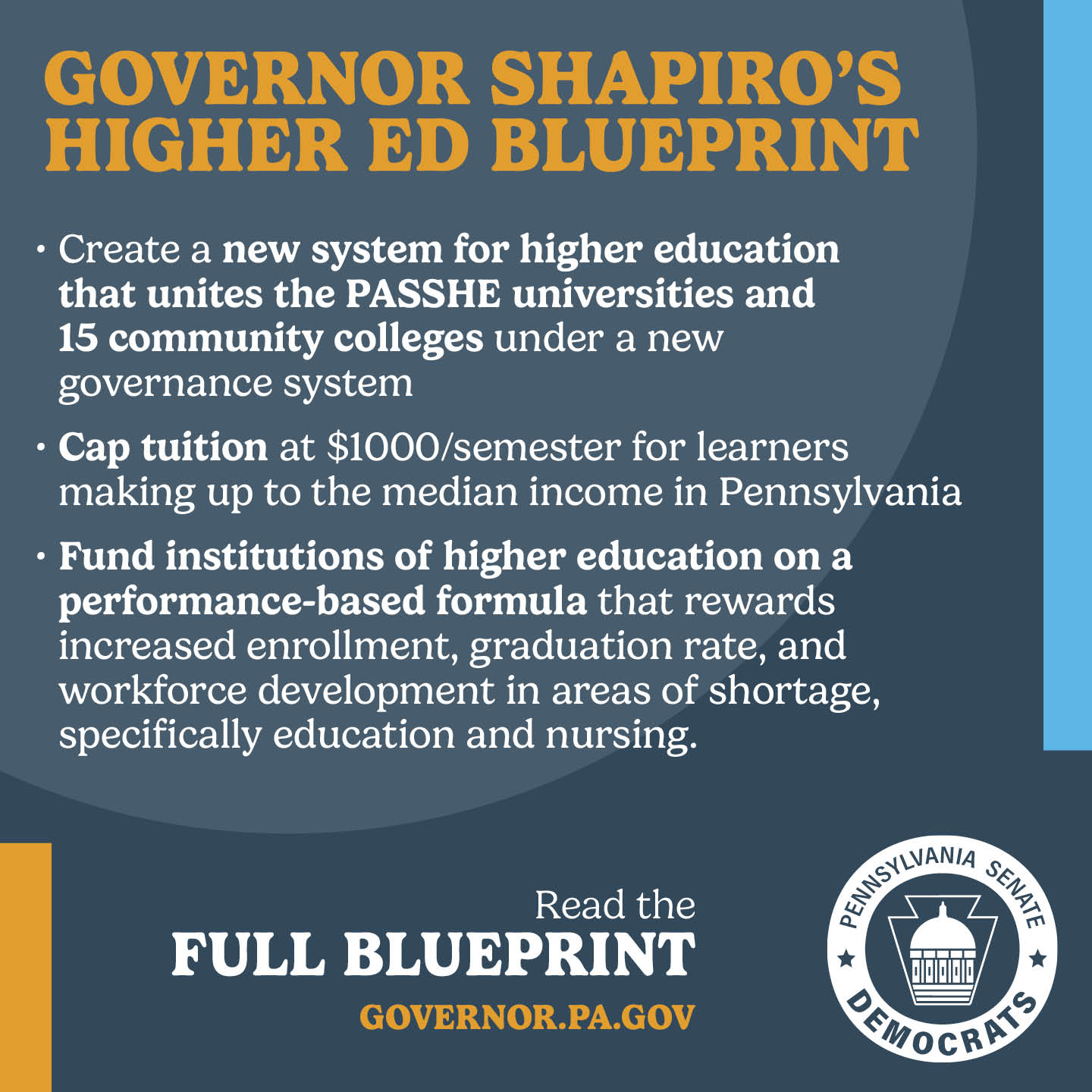
Governor Shapiro’s blueprint is accessible in full here. Among other things, the blueprint seeks to:
Create a new system for higher education that unites the PASSHE universities and 15 community colleges under a new governance system
Cap tuition at $1000/semester for learners making up to the median income in Pennsylvania
Fund institutions of higher education on a performance-based formula that incentivize increased enrollment, graduation rate, and workforce development in areas of shortage, specifically education and nursing.