HARRISBURG, February 15, 2012 — State Senate Democratic Leader Jay Costa (D-Allegheny) issued the following statement in reaction to public comments made by Senate President Joe Scarnati (R-Jefferson) regarding moving Pennsylvania’s primary election and the possibility of an early state budget:
“I agree with Sen. Scarnati that the primary election should not be moved. It should be held on April 24 as planned. Moving the primary date creates a number of problems and would result in a major cost to counties and taxpayers.
Furthermore, moving the primary is disrespectful to more than 100,000 thousand citizens who have signed nominating petitions and who are participating in the election process. The spirit, intent and letter of the state Supreme Court and federal court rulings would be disrespected if the primary were moved.
The redistricting process needs to be deliberate and thoughtful and it must include participation from the public. The Legislative Reapportionment Commission should not force a plan through without full consideration of the guidance provided by the state Supreme Court.
I also agree with Sen. Scarnati that the state budget should be considered in June after the revenue picture becomes clearer. As we learned last year, May and June are critical months for collection. Passing a budget before the state takes in such a significant amount of revenue has the potential to create unnecessary hardship and more burdens on our taxpayers, seniors, students and working families because the budget will be difficult. While meeting the budget deadline is something we must achieve, meeting it months early when we do not have all of the information necessary to make an educated decision is not in the best interest of Pennsylvania taxpayers.”
###
FOREST HILLS, February 10, 2012— Sen. Costa had the pleasure of spending time with 8-year-old Chloe Kondrich at his Forest Hills office to hear more about the importance of early Intervention and early childhood education.
[frame align=”right”]
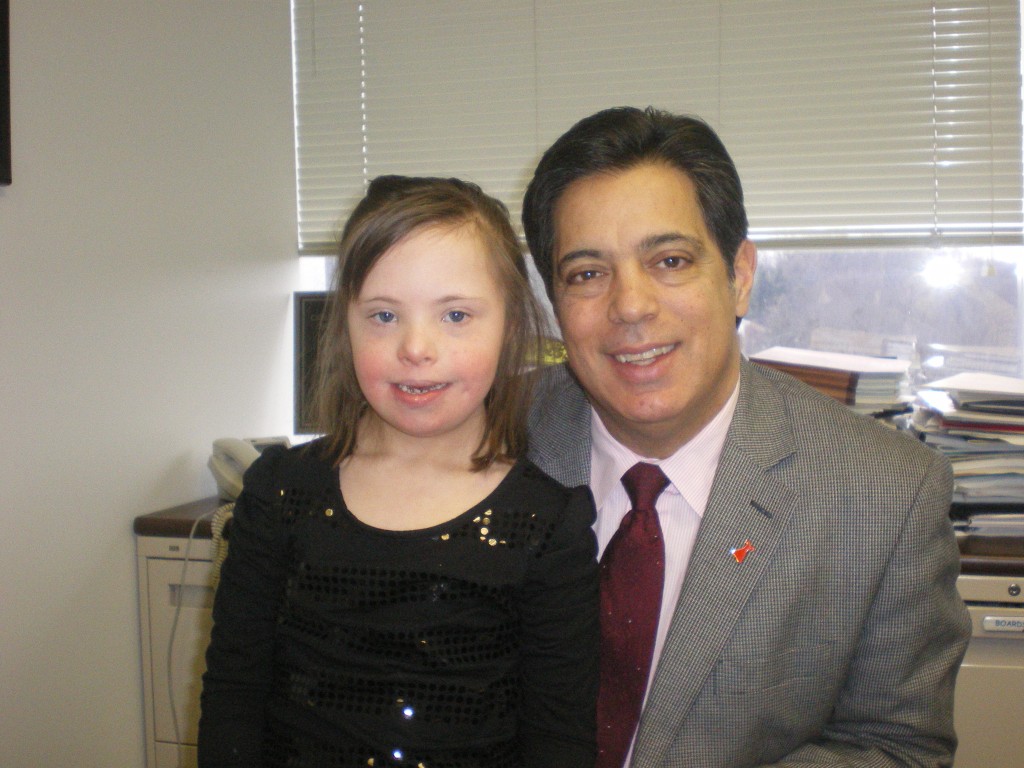
[/frame]Chloe’s father, Kurt Kondrich, is a strong advocate for early intervention and the full inclusion of children with disabilities. He serves as Director of Community-Family Outreach at Early Intervention Specialists, a Pittsburgh-based organization that provides early intervention services to children and their families in the counties of Allegheny, Adams, Butler, Washington, and York.Chloe has met with numerous elected officials, both on the state and national level, to share her story and promote the programs that encourage full inclusion of children with disabilities.
Chloe and her father thanked Sen. Costa for his long-term support of early intervention and education in Pennsylvania.
- Learn more about Chloe’s amazing story by visiting hear blog. → View Chloe’s Blog
- Read about Chloe’s recent meetings and advocacy. → Read More
- Learn more about the impact of state programs which provide support families of children with developmental delays by viewing Pennsylvania State Interagency Coordinating Council’s annual report. → View Report
- Learn more about Early Intervention Specialists. → Learn More
# # #
HARRISBURG, February 7, 2012 — “The governor’s budget address touched on the themes of compassion, reform, and responsibility. His words don’t reflect the cold and painful reality behind the numbers. [audio:https://senatorcosta.com/wp-content/uploads/2012/02/2012budgetaddressreaction.mp3|titles=2012budgetaddressreaction]
Cutting funding to early childhood education programs, higher education and tuition assistance, and programs which help bring care and comfort to our veterans and disabled is not compassionate or responsible.
[hdvideo id=26 ]
Pennsylvanians also value fairness – and fairness is something in short supply in the governor’s budget. For a second year, the budget sends the message that the middle class doesn’t matter. The governor has shown us where his priorities lie. Pursuing a Marcellus Shale policy which allows billion-dollar companies to get this resource at one of the lowest rates in the country does Pennsylvania a disservice. Big businesses get a break, but if you own a home, send a young child to a public school, or have a teenager going off to college, you take a hit. That is not fair. It is also not wise. Pennsylvania’s next generation is going to find it harder to get an education, get a job, and provide for their families. It won’t make our state appealing to anybody – not even big business.
Passing along tax increases to local governments in the form of higher property taxes is passing the buck. It is not responsible. Pennsylvanians know better.
The governor also announced another commission, this one to study post-secondary education. In one year in Pennsylvania, we have seen commissions meet, make recommendations, and move on. We can’t continue to talk about problems. We need to truly be responsible and do something to address these problems. Our roads and bridges don’t become safer and our public transit systems don’t improve through discussions. The time for talk is over.
In the coming months, we will do all we can to make the state budget a better reflection of Pennsylvanians’ priorities.”
# # #
“The Supreme Court said that the Reapportionment Commission has more work to do. And, we agree.
The court has required a plan with fewer splits, more compact and contiguous districts, and, that while population deviation is a consideration, it is equal to other constitutional provisions. Importantly, the court emphasized that splits of political subdivisions should be avoided unless “absolutely necessary.”
The commission needs to get to work and proceed mindfully and cooperatively with respect for citizen input, the constitutional provisions regarding fairness and equity and the court’s guidance. As the Supreme Court held, the LRC must draw lines that respect the language in the Constitution.
We have to do it right this time. This is an opportunity to draw districts reflecting the court’s guidance or citizens will, once again, legitimately challenge the plan’s legality. A new plan should not be rammed through the process, without due consideration for what the court has said about redistricting.
The Supreme Court has emphasized that the statewide district map of the General Assembly must respect our citizens.”
Pittsburgh, January 31, 2012 – Noting the six months of inaction since Gov. Tom Corbett’s blue ribbon transportation commission released its final report, Senate Democratic Leader Jay Costa (D-Allegheny) today joined county and legislative leaders in Pittsburgh to call on the governor to lead on transportation infrastructure and mass transit investment Pennsylvania.
“On the eve of the six-month anniversary of the release of the recommendations from the governor’s Transportation Funding Advisory Commission, we are still awaiting a plan for transportation from Gov. Corbett.” said Costa. “The governor’s own transportation commission issued its report, and it is his responsibility to lead. We don’t believe Pennsylvanians should have to wait any longer.”
[hdvideo id=24 ]
“It has been more than a year since Tom Corbett became governor, and half a year since his commission gave him a detailed plan for transportation funding,” said Rep. Frank Dermody, the House Democratic Leader. “We are lucky that so far it’s simply a matter of crumbling roads and weight-restricted bridges, but we are driving on borrowed time. If nothing is done, it will get much worse. Lives are at risk.”
Costa said that PennDOT statistics show that there are more than six million trips daily across Allegheny County bridges that are rated either functionally obsolete or structurally deficient, and more than 178,000 trips across bridges that have temporary supports or weight restrictions in place.
Costa said that an investment in infrastructure will create jobs. In 2010, Pennsylvania ranked seventh in the nation for job creation and has now slipped to 25th in the U.S. Bureau of Labor Statistics report issued last week.
 Last week, Senate Democrats also laid out their budget priorities in anticipation of another round of job-crushing cuts from the Corbett Administration during the governor’s upcoming budget address. The Senate plan calls for creating jobs through investments in our economy for infrastructure development and improvements, as well as targeted training and education programs for a quality workforce.
“Gov. Corbett’s Transportation Funding Advisory Commission report laid out options for the governor to choose, including uncapping the Oil Company Franchise Tax and raising licensure fees to support investments in highways, bridges and mass transit,” said Sen. Vincent J. Hughes, Democratic Appropriations Chair. “The time for studies, commissions, and conversing is behind us. It’s time to act. I urge the governor to take action and indicate to the legislature how he wants to move forward.”
“Gov. Corbett can move our economy forward — or stall it if he provides leadership to address our well-documented transportation problems,” said Rep. Joseph Markosek (D-Allegheny) minority chair of the House Appropriations Committee.
Sen. John Wozniak, who serves as the Democratic Chair of the Senate Transportation Committee and is a member of the state Transportation Commission, said “Pennsylvania’s two biggest challenges right now are its crumbling transportation infrastructure and the stagnant economy. It has been months since the Transportation Funding Advisory Commission released its report and it’s time for leadership from the administration on a plan that will keep drivers safe and keep commerce rolling.”
“We each know personally about the need for transportation funding,” said Rep. Dan Frankel, the House Democratic caucus chairman. “We know it as we swerve to avoid potholes, are forced to detour due to closed bridges, or wait in the cold for buses. Each individual story adds up to a story about our economic vitality. If we can’t move goods and people around because our bridges won’t bear the weight of trucks and our buses are idled, our economic growth will stall.”
Corbett’s Transportation Funding Advisory Commission issued its report on August 1, 2011. The commission was tasked with indentifying an additional $2.5 billion annually to address the transportation funding shortfall. In addition to its funding proposal, the Commission made suggestions for modernizing transportation.
The report noted that funding in Pennsylvania falls far short of needs, and points out specifically that the report is “about more than potholes—the issues at hand affect safety, our economy, and the environment, all of which shape the quality of life and ease of commerce in Pennsylvania.”
Costa and his legislative colleagues said they await word from the governor on how he wants to proceed, but more delay creates even more problems. Pennsylvania maintains the dubious distinction of having the highest number of structurally-deficient bridges in the country and the most miles of road in “poor” condition. An estimated 300 bridges are added to the structurally deficient list each year.
-30-
Harrisburg – January 25, 2012 – Senate Democrats, led by Democratic Leader Jay Costa, Appropriations Chair Vincent Hughes and others, today called on the governor to make job creation, tax fairness, education funding, shale and the restoration of funds for safety net programs budget priorities.
“We need a budget that moves Pennsylvania forward, not one that puts us in reverse,” Costa said. “We need to focus our energy on job creation, restoring education funding, providing sufficient dollars for safety net programs and improving transportation infrastructure.”
[hdvideo id=23 ]
[audio:https://senatorcosta.com/wp-content/uploads/2012/01/BudgetPCHome_Jan25_2012.mp3|titles=BudgetPCHome_Jan25_2012]
The Democrats outlined their budget priorities at a news conference in the state Capitol Media Center.
Costa said Senate Democrats have identified nearly $1 billion in new revenues from smart policy changes, efficiencies and a responsible shale tax that can be used to pay for their agenda.
Costa said Pennsylvania has regressed under Gov. Tom Corbett, who has produced no jobs plan while unemployment has stagnated. At the same time, the governor has driven education funding back to 2006 levels and funded higher education support at a level not seen since 1995, under former Republican Gov. Tom Ridge.
“Senate Democrats produced a comprehensive jobs plan called PA Works Now but we’ve heard nothing on jobs from the governor,” Costa said. “We are ready to move on transportation if he would lead and let us know how he plans to address that crisis.”
Hughes said Senate Democrats predicted chaos in education if Corbett’s plan to slice more than $1 billion was approved by Republican lawmakers.
“Senate Democrats voted against last year’s budget plan because we thought it would produce exceptionally high local tax bills, cut education quality and imperil schools,” Hughes said. “Now we have a crisis in the Chester-Upland district and there are at least ten more districts that may soon be in a similar position.
“Insolvency will spread beyond poor schools and spill over into adjoining districts as a result of Governor Corbett’s education and fiscal policies.”
Hughes said that unemployment rose sharply after Corbett took office and it has taken one year to recede, noting that on jobs “we treaded water for a year.”
Sen. John Yudichak (D-14th), who has been the Senate lead negotiator on Marcellus Shale, said that his region in northeast Pennsylvania has been hit hard by job loss and education cuts.
“We need to make strategic investments and create jobs and we can do that by adopting a responsible shale drilling plan that generates money for rebuilding roads and other infrastructure while we protect the environment and our communities with tough regulations,” he said.
