
Back to the Negotiating Table, Lawmakers Urge

PITTSBURGH – Protecting access to good health care for residents is a top concern for regional lawmakers as the leaders and members of the General Assembly today urged Highmark and UPMC to get back to the bargaining table.Sen. Costa addresses the media
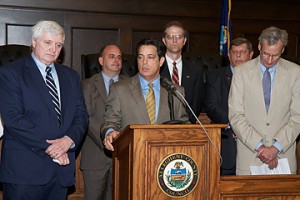
House Majority Leader Mike Turzai (R-Allegheny County), House Democratic Leader Frank Dermody (D-Allegheny County), Senate Democratic Leader Jay Costa (D-Allegheny County), and members from the three legislative caucuses met today in the Allegheny County Courthouse to discuss the dispute between the two health care agencies.

The members announced they sent a formal letter to the two entities to sit down with legislators to discuss the status of negotiations. Hearings will be held by the House Insurance Committee and the Senate Banking and Insurance Committee to determine what, if any, legislative or regulatory remedy is available.

“These are two huge community assets in western Pennsylvania, and we can’t sit on the sidelines as constituents are seriously worried about their ability to see a doctor,” Turzai said. “They need to work out these important issues without cutting off access to the quality health care.”

“Highmark and UPMC are two of our region’s largest employers and they are crucial parts of the health framework for thousands of Pennsylvanians,” Dermody said. “This public dispute is causing great concern to retirees, workers with families, and employers all over. We cannot shut the door on people’s access to doctors or hospitals. This fight needs to end.”

“We want to make certain the public’s interest is being served by these two major players in delivering health care to Western Pennsylvania. The public clearly won’t be served if health care access is limited, restricted, or disrupted in any way. That must be avoided,” said Costa. “No matter where people seek care — Hillman Cancer Center, West Penn Burn Center, Magee-Women’s Hospital or any of the other institutions that are so heavily relied upon – the public needs to be assured that the high level of care they have received in the past will not be impacted.”

UPMC is the region’s largest hospital and doctor network. Highmark controls 65 percent of the region’s health insurance market in western Pennsylvania, extending from the Pittsburgh region up north to the Erie area.

UPMC and Highmark are in the last year of a 10-year provider agreement, which allows Highmark members to see UPMC doctors and use UPMC hospitals; the contract ends June 30, 2012. Negotiations for a new contract broke off when Highmark began considering acquiring the financially troubled West Penn Allegheny Health System, a major UPMC competitor (West Penn Allegheny is the Pittsburgh region’s second largest hospital network).

Highmark has since reached a preliminary agreement to buy West Penn Allegheny, which prompted UPMC to end talks and open its network to other commercial insurance carriers. 

If Highmark and UPMC do not reach an agreement, 2,700 UPMC doctors and affiliated hospitals will become out-of-network providers to approximately 3 million Highmark subscribers. Out-of-network fees are generally much higher than in-network doctors and hospitals, increasing out-of-pocket expenses for consumers.

###


Carbon Monoxide Detectors Made Available

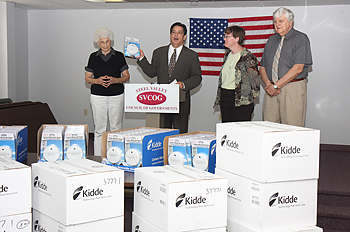
Costa displays carbon monoxide detectors

Sen. Costa talks about the carbon monoxide detectors available. Also pictured is Homestead Mayor Better Esper (far left); An Lewis, executive director of the Steel Vally Council of Government; and West Homestead Mayor Ray Bodnar.

HOMESTEAD – Homestead Mayor Betty Esper was lucky to escape with her life in November 2010 when a blocked vent pipe in her home caused a dangerous build-up of carbon monoxide that sent both her and a tenant who lived in the home to the hospital for treatment.

Upon her recovery, she vowed to do make sure that Mon Valley residents understood the dangers of carbon monoxide and the importance of having a CO detector in the home.

Now, thanks to a $5,000 state grant secured by Sen. Costa through the state Department of Health, Mon Valley residents who cannot afford a detector can obtain one of 412 units available at their local borough building. The detectors are free of charge for needy families and senior citizens and are available in the municipal buildings in Boroughs of Braddock Hills, Dravosburg, Homestead, Munhall, West Elizabeth, West Homestead, West Mifflin and Whitaker, and the City of Clairton.

Esper worked with West Homestead Mayor Ray Bodnar, president of the Steel Valley Council of Governments, to get a discounted price from Lowes Home Improvements, located in the Waterfront development.

 ###


Costa Honored by Neighborhood Legal Services

PITTSBURGH – Sen. Costa was recently honored by the Neighborhood Legal Services Association for his work to promote the mission of the NLSA in providing legal services to individuals and families in Western Pennsylvania.

Read more by viewing Sen. Costa’s profile in the NLSA’s publication “A Tribute to Our Honorable Alumni.”

Costa serves as a board member of the NLSA. To learn more about the NLSA, visit their website at www.nlsa.us.

As a member of the Senate of Pennsylvania, Costa strives to ensure that legal service groups like the NLSA receive adequate funding in the state budget each fiscal year.

Republican Budget Hurts Students, Cuts Teachers, and Slows Job Creation

HARRISBURG — Senate Democratic Leader Jay Costa (D-Allegheny) issued the following statement after passage of the $27.15 billion state budget which all Democrats voted against:

“We have been calling for a state budget that reflects shared sacrifice and fairness to all Pennsylvanians since March. It is now clear that our consistent calls fell on deaf ears. This budget disproportionately affects our middle class while jeopardizing the quality and affordability of our education system at all levels, pre-K through college.

The state budget, the product of a closed-door deal crafted by Republicans in the House, Senate, and Governor’s office, contains a cut of more than $900 million to basic education, while also drastically reducing state support to community colleges (10 percent cut), state system (18 percent cut) and state related (19 percent cut) colleges and universities. It eliminates the funding for charter school reimbursements which were funded at $224 million last year.  This hurts our most economically-challenged districts at the worst possible time. 

Not only will this budget force thousands of teachers to lose their jobs, but it also puts our economic recovery at risk. Cuts to successful job creation initiatives with a proven track record will stall. This budget makes significant funding cuts to business incubators and small business development centers. It will also force these entities, along with Industrial Resource Centers and Industrial Development Agencies to compete for the limited funds. Furthermore, state funding to our academic medical centers will be slashed in half. These research and teaching hospitals are economic engines that not only drive medical and research jobs into our communities, but attract millions in federal grants and private investment. This budget is a blow to medical institutions and the communities, like Pittsburgh, which have thrived and benefitted because of them.

In addition to education cuts, the Republican budget also fails to dedicate enough funding to the hospital assessment to draw down much-needed federal funds. Hospitals will also be forced to pay for more costs as a result of this budget.  While there is modest restoration for uncompensated care — $16.5 million — it is not nearly what is needed, further crippling hospitals. 

We understand there is a need to be fiscally responsible in the current economic climate, but this budget falls far short of being responsible by cutting from those that need it the most. It is not responsible to make a commitment to big business at the expense of education. It is unfathomable that we are going to pass a budget that will lay off thousands of teachers and leave students in packed classrooms while stashing away hundreds of millions of dollars in revenue.

It is not responsible to allow natural gas companies to make millions in profits while local communities are left to deal with the consequences and the costs of gas drilling.

It is a new day in Pennsylvania. In this Pennsylvania, we ask the poor to sacrifice and suffer, the middle class to make concessions and do all we can to make sure that the rich get richer. This is a Pennsylvania characterized by closed door deals and beholden to big business. This is not a path that I want to see our state go down, and this is not a state budget I can support.”

###


Costa fights to restore cuts made to University of Pittsburgh

HARRISBURG – Senate Democratic Leader Jay Costa continued to push Republican leadership to restore unreasonably deep budget cuts on Sunday night by introducing an amendment to restore state funding to the University of Pittsburgh to last year’s level without raising any taxes or fees.

Costa’s amendment to Senate Bill 1123 would have reinstated the nearly $32 million state funding cut proposed to the University of Pittsburgh in the Republican’s budget ‘agreement’ by looking at cost efficiencies within the Department of Corrections budget and federalizing inmate health care provided outside institutions.

“It is unconscionable that our Republican counterparts are inclined to leave hundreds of millions of dollars on the table while our middle class and our students are going to shoulder an unnecessary and potentially crippling financial burden in this budget,” Costa said.

“The University of Pittsburgh is regarded nationally as one of the finest higher education institutions and public research facilities in the country.  By taking away this state investment and forcing our state institutions to raise tuition, we are effectively crushing the higher aspirations of many Pennsylvania families who will now be unable to afford the cost of a college education.”

Costa’s amendment fell short by a party line vote of 30-20.

# # #

Costa, Ferlo and Fontana announce grant for natural gas-powered refuse trucks

HARRISBURG – The City of Pittsburgh will be awarded a $500,000 grant to purchase four new refuse trucks powered by compressed natural gas (CNG), state Sens. Jay Costa, Jim Ferlo and Wayne Fontana announced today.

The funds were awarded through the state Department of Environmental Protection (DEP) using American Recovery and Reinvestment Act monies. No other project in the commonwealth was capable of combining an operational public-access CNG fueling facility with a natural gas-fueled public refuse fleet within ARRA’s time constraints.

“This is a pilot project, but the long-term goal is to replace the city’s entire fleet of refuse trucks to CNG as a fuel source,” Costa said. “There are 80 trucks operating in the city limits that could eventually be operating on natural gas.”

The DEP estimates that the conversion of just four trucks to CNG will reduce CO2 and other pollutants by over 200,000 lbs. per year. In addition to the reduction in air pollution, the project will significantly cut fuel expenses.

“This is a project that pays for itself over time,” said Ferlo. “Although CNG trucks cost more to purchase than a traditional truck, the annual fuel savings of $9,600 per vehicle would return the initial investment in less than four years.”

Fontana said the project would set a good example for other cities and large municipalities in Pennsylvania to follow. “With its strong commitment to green energy projects, Pittsburgh continues to make its mark as a city that innovates,” Fontana said. “This is another example of how our city is leading the way.”

The fueling station will be operational by July 2011 and is located within two blocks of the public works facility.

###