HARRISBURG, PA − June 27, 2018 − The PA Senate Dems filed the below cosponsorship memo this afternoon to combat the potential negative impacts of the SCOTUS ruling on Janus vs AFSCME today.
Here’s a statement from Democratic Leader Jay Costa, Jr.
Today’s decision by the U.S. Supreme Court in the Janus case is disappointing, and disheartening for the millions of middle class workers who depend on strong unions to advocate for them in the workplace. This ruling gives employers more leverage, and divides workers amongst themselves. While this is undoubtedly a setback for workers’ rights, it is not and cannot be a death knell for public sector unions. We must do more at the state level to protect the middle class and their rights in the workplace.
HARRISBURG, PA − June 22, 2018 − The Pennsylvania Senate passed the state budget for Fiscal Year 2018-19 (House Bill 2121) by a vote of 47-2.
“In January, the Senate Democratic caucus outlined our priorities for the year and this budget puts the money where our mouths were,” said Senate Democratic Leader Jay Costa, Jr. “It makes major investments in education at every level, workforce development, health care and social justice. It’s the product of months of bipartisan work and compromise, and I’m proud to support a budget that so aptly reflects our values.”
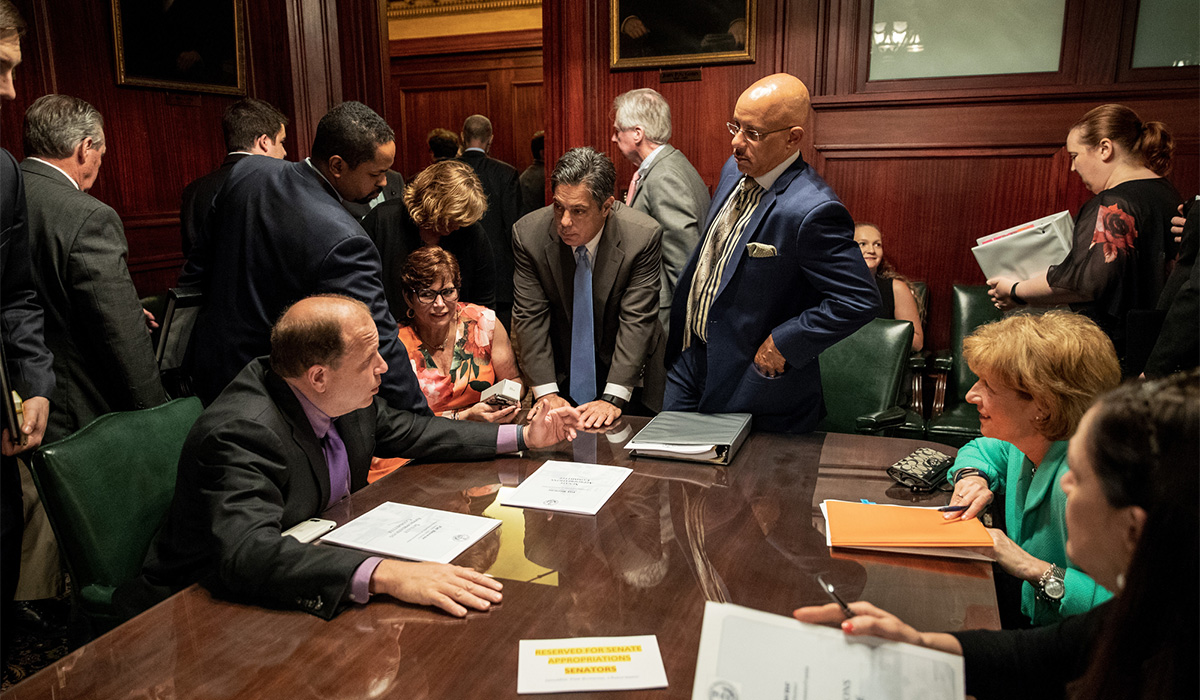 Senate Democratic Appropriations Chairman Vincent Hughes noted that the budget restores the billion-dollar cuts to education funding under the administration of Gov. Tom Corbett. He added that he is hopeful investments in the people of the commonwealth continue to be of the highest priority.
“The increased investments to education, job and economic initiatives, social justice, and health care in this year’s budget are a testament to what happens when we work together and put the people first,” Senator Hughes said. “On a personal note, I am pleased this budget negotiation ended in a timely fashion and believe this is the foundation for future bipartisan budget negotiations.”
The Senate Democratic Caucus priorities in this budget focus on four categories: education, jobs and workforce development, social justice and health care. The budget incorporates major investments in those state programs, including:
- In education:
- $100 million increase in basic education (K-12 public schools)
- $20 million increase in Pre-K Counts program
- $30 million increase in career and technical education as part of the PA SMART Initiative
- $15 million increase in special education
- $21.6 million increase in Early Intervention
- Nearly $7 million increase to community colleges
- $15 million to the state-owned universities of the PASSHE schools
- In job and workforce development:
- A new $7 million apprenticeship training program through PA SMART
- $3 million increase to industry partnerships through PA SMART
- $3 million increase to combatting the Spotted Lanternfly infestation that threatens our agricultural industry
- In social justice:
- $1.3 million to the Human Relations Commission to provide the resources necessary to investigate claims like those of the Grandview 5.
- $1 million for It’s On Us grants to address campus sexual assault
- In health care
- Includes funding to address the Governor’s waiting list initiatives.
- 100 persons on the emergency waiting list for intellectual disabilities (ID) and 800 high school graduates aging into the ID waiver program.
- 40 adults off of the Autism Intervention and Services waiting list.
- Provides funding to expand home visitation programs for parents and young children.
- $2.5 million to fight Lyme disease
The General Appropriations bill passed in the Pennsylvania House on Wednesday, and now goes to Governor Tom Wolf’s desk to await his signature.
###
HARRISBURG, PA − June 12, 2018 − The Pennsylvania Senate Democrats voted unanimously against a Senator Aument amendment to create judicial districts, as part of the redistricting reform bill, Senate Bill 22.
Ultimately, the amendment passed by a partisan vote of 31 to 18, with several Republicans voting against it as well.
Senate Bill 22 was intended to create an independent commission for the redistricting process, to prevent gerrymandering and ensure fair, competitive elections. The irony and hypocrisy of the amendment from Senator Aument is that its purpose is to gerrymander the court system. It would create commission-drawn districts for judges – instead of statewide elections, as they are now.
“This amendment hijacked a well-intentioned bill to restore public faith in government,” said Senate Democratic Leader Jay Costa, Jr. (D-Allegheny). “The Republicans who voted for it are doing so in retaliation for the Supreme Court’s recent decision on their gerrymandered maps from 2010. It would ensure a Republican majority on the court, while the advocates and supporters of Senate Bill 22 have been pursuing fair elections. The Republicans in the Senate who voted for this amendment are complicit in working aginst the goals of Senate Bill 22.”
“Senator Aument’s amendment is a poison pill to many in our caucus, and we have heard the same from good government organizations including Fair Districts PA, Committee of 70 and the League of Women Voters,” Senator Costa continued.
“Here we are: bamboozled, run amok, led astray, taken down one path and led to another,” said Senator Vincent Hughes (D-Philadelphia). “The gerrymandering we were supposed to be addressing in 22 has turned into creating gerrymandering in the election of judges.”
“This is not the time or place for this amendment,” said Senator Lisa Boscola (D-Lehigh), the prime sponsor of Senate Bill 22, during floor debate. “Without consensus or further vetting, it is wrong to attach this controversial amendment to Senate Bill 22. Unlike Senate Bill 22, there have been no hearings on this issue, and we have not heard from experts. There have been no working groups or analysis as to why this proposal could be better than what we have now. Please colleagues, do not let this bill be hijacked.”
“This [amendment] does not make us a stronger Commonwealth, this divides us,” said Senator Anthony H. Williams, the Democratic chair of the State Government Committee.
Senate Bill 22 is expected to be voted on final passage, in its amended form, on Wednesday, June 13.
###
HARRISBURG, PA − June 6, 2018 − For the past several months, the Senate has been working with constituents and advocacy organizations to improve the fairness of Pennsylvania’s redistricting process. That work took the shape of Senate Bill 22, sponsored by a majority of the Senate.
Three weeks ago, Senate Bill 22 was amended, and many organizations and individuals have reached out with concerns about the latest version of the bill.
We are working with the chairs of the State Government Committee, Senators Williams and Folmer, to address some of those concerns through additional amendments on the following issues:
- Diversity: The Commission should reflect the geographic, racial, ethnic and gender diversity of the Commonwealth
- Eligibility for the Commission: Prohibiting registered lobbyists, and the staff and families of elected officials from serving on the commission
- Party registration: Commissioners should be continuously registered with the same party or unaffiliated, without changing that affiliation for at least three years; and the three non-Democratic or Republican members of the commission should not all be registered with the same ‘third party’
- Compensation: Commission members should be compensated prior to the passage of their preliminary redistricting plans
- Map timeline: Remove the 30-day period to file an appeal of the Commission drawn plan to the Supreme Court; add December 31st of the year ending in 1 as the deadline for the General Assembly to approve a plan
###
Pittsburgh, Pa. − May 22, 2018 − The Senate Health and Human Services Committee voted unanimously in support of Senate Bill 1001, Senate Democratic Leader Jay Costa, Jr.‘s legislation that will allow the Department of Health to declare public health emergencies. The declaration would last 90 days but give the Secretary of the Department of Health the capability to extend it.
“Currently, the Governor has declared a disaster emergency to provide state government and public health providers with additional tools to fight the opioid epidemic,” said Senator Costa. “However, a public health emergency declaration would be better suited for this crisis, and my legislation would create and outline such a distinction.”
SB 1001 will also provide a hands-on approach to help end the opioid crisis. It will also give authorization to the Department of Health the ability to waive current regulations and create new temporary ones. It will publish notices in the Pennsylvania Bulletin for tracking and treating a disease, illness, or event. This legislation will also allow public workers to provide treatment to help control the emergency. Lastly, the bill will provide a form of liability for people responsible for committing the future act.
The legislation defines public health emergency as an event that poses an imminent threat and meets two criteria:
Is caused by:
- bioterrorist event, a biological, chemical or nuclear agent, a chemical attack, or a nuclear attack
- The appearance of a novel or previously controlled or eradicated infectious disease
- A natural disaster, accidental chemical release, or nuclear incident
- A disease outbreak
Poses a high probability of:
- Deaths
- Serious or long-term disabilities
- Widespread exposure to an infectious or toxic agent that poses significant risk or substantial present or future harm to many people.
Governor Tom Wolf is also championing this fight and announced the renewal of the 90- day Disaster Declaration in the opioid crisis earlier this spring.
###
Pittsburgh, PA − May 8, 2018 − Governor Tom Wolf today announced the certification of eight medical facilities as academic, clinical research programs for medical marijuana. Among those certified is the University of Pittsburgh Medical Center.
Senate Democratic Leader Jay Costa, Jr. applauded the decision to certify UPMC and looks forward to the work the facility produces.
“UPMC is already a top notch medical resource in our community, and this additional certification is going to enhance its research capabilities,” said Senator Costa. “When we considered medical marijuana legislation at the state level, we were highly interested in the outcomes of children and people with epilepsy when treated with this medication. I’m anxious to see the research and conclusions UPMC is able to reach.”
More than 37,000 patients have registered to participate in the medical marijuana program, with over 16,000 who have received their identification cards and received medical marijuana at a dispensary. 1,000 physicians have registered for the program with more than 600 certified as practitioners.
Since Pennsylvania’s medical marijuana program was created, the Administration has:
- Completed temporary regulations for growers/processors, dispensaries, physicians, patients, laboratories, and academic clinical research centers and clinical registrants, all of which have been published in the Pennsylvania Bulletin;
- Issued Phase I permits to grower/processors and dispensaries;
- Developed the Medical Marijuana Physician Workgroup; Convened the Medical Marijuana Advisory Board;
- Approved six training providers for physician continuing-education;
- Approved four laboratories to test medication before it is delivered to patients;
- Launched registries for patients and caregivers, as well as physicians;
- Approved 23 dispensaries and 12 grower/processers to begin operations;
- Issued permit applications for Phase II of the program for grower/processors and dispensaries.
The Medical Marijuana Program offers medical marijuana to patients who are residents of Pennsylvania and under a practitioner’s care for the treatment of a serious medical condition as defined by the Medical Marijuana Law.
###
