Harrisburg – March 19, 2018 – State Sen. Jay Costa (D-Allegheny) released the following statement on today’s decision from the federal court on redistricting:
I applaud the federal court for denying the Republican challenge to the new map. The map provided by the state Supreme Court are fair, reasonable and constitutional – unlike the 2011 unconstitutional gerrymander we had before.
On a practical note, we are nearly through the entire period of petition signing and there are already candidates filed in most of the districts outlined by the state Supreme Court. To undo that work by the candidates and Department of State would throw this entire year of elections into disarray.
The decision today protects free and fair elections.
Pittsburgh, PA – March 12, 2018 – On Thursday, March 22, Senator Jay Costa, Jr. will host and moderate a roundtable discussion at the Carnegie Library in Oakland.
The event is titled “A Conversation on Women in Government, Advocacy, and the Private Sector” and will feature panelists from each of those fields answering questions on the policies, challenges and opportunities that impact women in the workplace and in elected office.
Questions can be submitted ahead of time to Senator Costa’s Facebook page, www.facebook.com/SenatorCosta or Twitter, www.twitter.com/senatorcosta , or through the contact form on his website, www.senatorcosta.com
DATE: Thursday, March 22, 2018
TIME: 6:30-8PM
WHERE: Carnegie Library in Oakland
4400 Forbes Ave, Pittsburgh, PA 15213
WHO:
- Senate Democratic Leader Jay Costa, Jr.
- Jennie Sweet-Cushman, Assistant Director of PA Center for Women and Politics and Chatham University
- Heather Arnet, CEO of the Women & Girls Foundation
- Representative from Highmark
Media is strongly encouraged to attend!
PITTSBURGH, PA – February 27, 2018 – Senate Democratic Leader Jay Costa today announced that the Borough of Verona will receive a $200,000 grant from Pennsylvania Department of Transportation (PennDOT) to install Automated Red-Light Enforcement (ARLE). Verona will use the funds on a new traffic signal at the intersection of Allegheny River Boulevard and Wildwood Avenue.
“Automated enforcement at red lights can drastically improve the safety of an intersection, and state support is so critical to having them installed in our local municipalities” said Senator Costa. “They’ve been proven successful in reducing accidents and improving traffic flow around the state, and I’m glad that my district will get one through this grant.”
Pennsylvania’s ARLE program aims to improve safety at signalized intersections by providing automated enforcement at locations where data shows red-light running has been an issue. Projects were selected by an eight-member committee based on criteria such as benefits and effectiveness, cost, local and regional impact, and cost sharing.
Allegheny County will also get several others this year:
- Coraopolis Borough – $165,000 to upgrade the traffic signal at the intersection of Route 51 (4th Avenue) and Mulberry Street by improving signal visibility and pedestrian safety.
- McCandless Township – $135,000 to install new LED pedestrian signal indications, push buttons, and emergency vehicle pre-emption at seven intersections throughout the township.
- Springdale Borough – $192,000 to upgrade the traffic signal at the intersection of Route 1001 (Pittsburgh Street) and Butler Street by improving traffic signal supports, installing LED modules, improving pedestrian facilities, and upgrading controller and detection systems.
- Verona Borough – $200,000 to installation of a new traffic signal at the intersection of Allegheny River Boulevard and Wildwood Avenue.
The law specifies that projects improving safety, enhancing mobility and reducing congestion can be considered for funding. Municipalities submitted more than 143 applications, totaling over $34 million in requests.
###
Harrisburg – February 22, 2018 – State Sen. Jay Costa (D-Allegheny) released the following statement divesting state funds from companies that produce assault weapons:
“Following the recent and tragic school shooting in Parkland, I was mortified to learn that the Florida teachers’ retirement fund invests in the manufacturers of assault weapons. Assault weapons are incongruous with the values of our state and its schools – and I’m working to ensure that Pennsylvania makes no similar investments.
Money is the universal language, and it’s time that we send a message to those who profit from the creation and sale of assault weapons.
The first step I’ve taken is a letter to the Public School Employees’ Retirement System (PSERS), the State Employees’ Retirement System (SERS), and the Pennsylvania Municipal Retirement System (PMRS) asking for a thorough review of all of their investments to conclude whether any such investments have been made.
I hope this review finds that public dollars have not been used to fund weapon manufacturers, but either way, I will be introducing legislation to bar such investments moving forward. I am currently drafting a bill that would amend the existing Protecting Pennsylvania’s Investment Act (Act 44 of 2010) by adding a new investment prohibition – companies that manufacture assault weapons and large capacity ammunition feeding devices.”
Download Letters →
Download Co-sponsorship Memo →
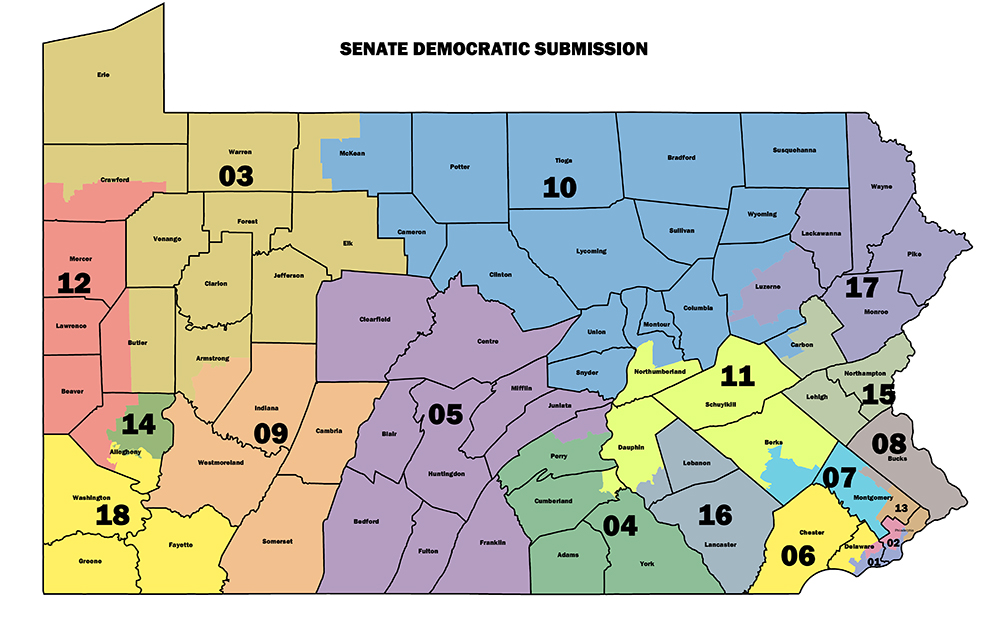 Harrisburg – February 15, 2018 – Senate Democratic Leader Jay Costa (D-Allegheny) released the following statement concerning the submission of a congressional redistricting plan to the state Supreme Court.
Senate Democrats submitted the plan following the court’s ruling that declared the 2011 maps unconstitutional. The Supreme Court gave the General Assembly until Feb. 9 to present a constitutional plan to the governor. Instead, Republican leaders submitted their own plan to the governor.
Costa’s statement follows:
“Senate Democrats submitted an excellent congressional redistricting plan to the court today. It meets the key elements of constitutionality identified by the court. The plan includes far less municipal splits than the Republican submission or the 2011 plan, adheres to the requirements of the Voting Rights Act and eliminates voter confusion by not moving any incumbent member of Congress who is seeking re-election this year or anyone who is involved in a special election.
“The previous map that was thrown out by the court was a jumbled mess that made no sense to the voters and was generally thought to be the worst congressional gerrymander in the country. The map Senate Democrats sent to the court today rectifies the many problems that were identified by the court and independent observers and is far superior to the map submitted by Republican leadership.”
Highlights of the Senate Democratic map:
- The map produced by Senate Democrats contains far fewer subdivision spits than either the Senate Republican submission or the 2011 plan.
- The 2011 map contained 172 splits, while the Senate Republicans’ contained 62 splits of counties, municipalities, wards and precincts. The Senate Democratic map includes only 55 splits.
- The Senate Democratic map’s districts are nearly equal in population and satisfies the requirements of the Voting Rights Act of 1965.
- The map retains a nearly identical composition of African-American and Latino populations in Pennsylvania’s 1st District while the 2nd District keeps the percentage of African-American voters relative to the 2011 plan constant.
- The Senate Democratic plan is far better than other plans on the measures of compactness identified by the court.
- In order to prevent voter confusion in this election cycle, the plan does not move any incumbent member of Congress who is seeking re-election.
-30-
Download Democratic Map →
Harrisburg, Pa. − February 13, 2018 − Senate Democratic Leader Jay Costa fully supports Governor Wolf’s decision to reject the maps presented to him last week by just two Republican members.
“A proposal that makes districts slightly more compact but no more fair or representative fails to meet the requirements set forth by the Pennsylvania Supreme Court,” said Senator Costa. “This is unfortunately yet another gerrymandered overreach that cannot be used. I’m glad that Governor Wolf agrees and has rejected the proposal.”
Governor Wolf’s administration hired an expert to review the proposed map by the Republican leadership, and found it “extremely, and unnecessarily, partisan.”
Professor Dunchin, the statistical expert, found that there was no more than a .1 percent chance that any plan drafted to comply with the state Supreme Court’s order could have been as favorable to Republicans as they one they shared with the Governor last Friday night.
“We could have had an open, bipartisan process and debate in the creation of a new map through legislation,” said Senator Costa. “Unfortunately, that was not what the Republican leaders wanted and now we will use our limited time before the February 15th deadline to find another solution.”
The original decision in this case by the state Supreme Court indicated that if the legislature failed to produce a plan that the Governor agreed to, that it would initiate its own map creation and distribute a completed product by Monday, February 19.
###
