Statewide, Pa. – August 10, 2020 – The Pennsylvania CDFI Network and the PA State Senator Democrats today announced $96 million in grant awards under the COVID-19 Relief Pennsylvania Statewide Small Business Assistance program. The small businesses that have been approved for awards span all 67 Pennsylvania counties.
“These grants and the relief they will provide are testament to what we can do when we prioritize the right initiatives,” said Sen. Vincent Hughes (D-Philadelphia/Montgomery). “It is because of collaboration and a collective focus that today we were able to deliver help to the auto body shops, the barbershops, the beauticians, the pizza shop owners, the soul food establishments and other businesses across the commonwealth. And though we are gathering today virtually to recognize the positive impact these grants will have, it is critical to understand that there is still a great deal of need and must continue to direct resources and aid to our small business community to help it recover from the devastation of the pandemic.”
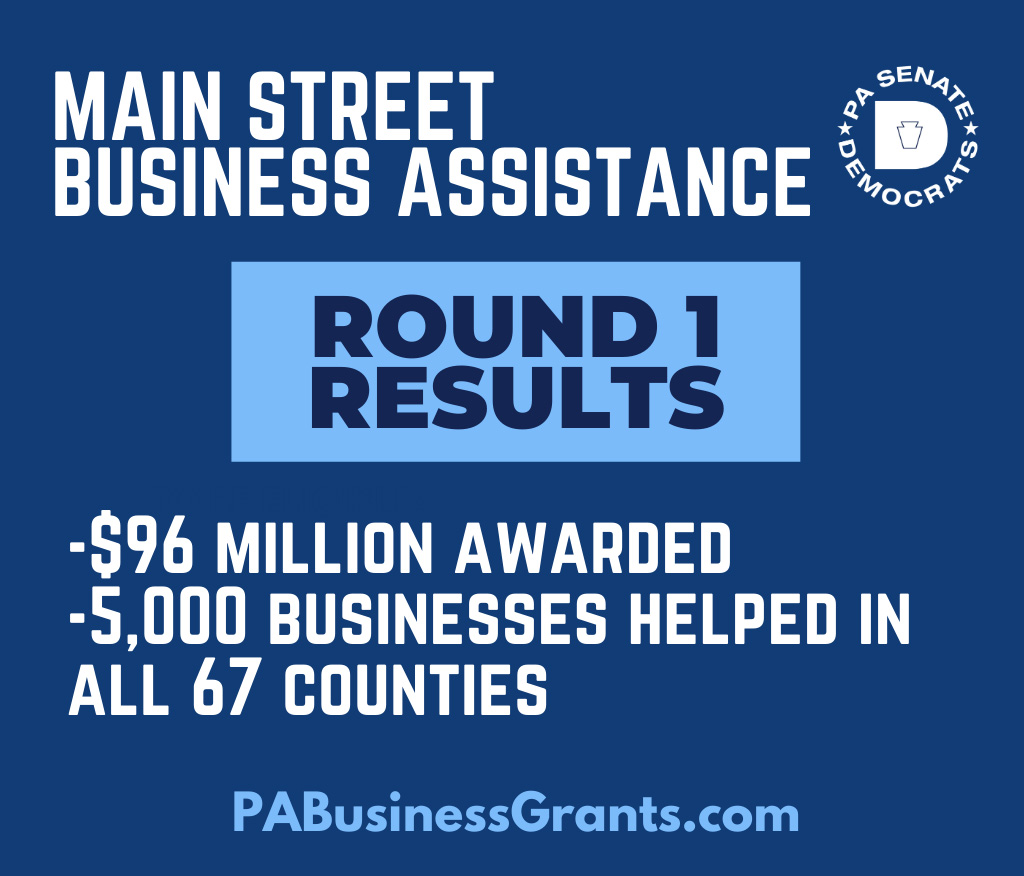 The program is part of $225 million in statewide relief championed by the senate democratic caucus in June to support small businesses economically impacted by the pandemic. The first application round drew a strong response with nearly 24,000 applications.
“We’ve seen the impact of this pandemic-fueled economic crisis on the small businesses in our communities and in the immense response to the program in the first round of applications,” said Daniel Betancourt, President & CEO of Community First Fund and Chair of the PA CDFI Network. “The PA CDFI Network is grateful for the partnership of Governor Wolf and the Pennsylvania Legislature as we move quickly to get these resources into the hands of those most impacted by the crisis.”
Of the close to 5,000 small businesses approved in the first round of funding, 50% are historically disadvantaged businesses that have traditionally experienced discrimination when seeking financial services and financial products. Over 2,400 of the businesses are also in communities targeted for business investment by state government programs like Main Street and Elm Street.
“I could not be more proud or more grateful for the great work of DCED and Pennsylvania’s CDFI Network in delivering substantive, fair, equitable, need-based assistance to our state’s main street and historically disadvantaged small businesses. Our program design and the accountability it provides to taxpayers and to our federal funders is a model for the nation,” Senator Blake (D-Lackawanna) said. “I appeal to the US Congress and to our colleagues on both sides of the aisle in Harrisburg to recognize the success of this program in assisting small businesses devastated by the pandemic and to invest further in the program so we can help even more of them.”
The program has targeted getting grants to small businesses with the greatest need and to be eligible to apply businesses had to have less than $1M in revenue and less than 25 employees. Grants ranged in size from $5,000 to $50,000 based on the revenue size of the business. More than 2,300 of the grantee business owners are low-moderate income.
“Our business community has been severely impacted by the COVID-19 pandemic and is in need of immediate assistance. The grant program is targeted to help small businesses manage costs, handle expenses, and stay in operation in this exceptionally difficult time,” said Senator Brewster (D-Allegheny). “Since COVID struck our state and debilitated our business community, I have been advocating for bridge grants and sought millions in aid for impacted businesses and workers. The small business assistance grants are one of the tools we can use to bolster business, maintain jobs and help workers at a time of immense distress.”
More than two thirds of the approved awardees are women-owned businesses and 16 percent located in rural communities. The businesses represent industries that have been especially hard hit by the pandemic including retail, food and hospitality, health and wellness, and personal care.
| Industry |
Applications Approved |
Amount (Millions) |
| Restaurants & Other Eating Places |
1,608 |
$25.80
|
| Drinking Places (Alcoholic Beverages) |
202 |
$4.63
|
| Personal Care Services |
1,001 |
$24.52
|
| Other Amusement and Rec. Industries |
180 |
$3.46
|
| Totals |
2,991 |
$58.41
|
“For minority and women-owned businesses in Pennsylvania COVID-19 didn’t create a crisis, it laid bare the crisis our minority entrepreneurs have been facing for decades,” House Democratic Finance Committee Chairman Jake Wheatley Jr (D-Allegheny) said. “While I’m glad to see the positive impact of these grants and I urge all local community businesses to apply for the next round of grants, we need to expand investment in programs like this because it’s long past time for the legislature to address the systemic flaws that are leaving too many marginalized people behind.”
The second grant application window for the relief funds opened today, August 10, and will remain open for 15 business days closing at 11:59PM on August 28.
“Our small business owners need our help and support,” said state Rep. Carolyn Comitta, D-Chester. “After limited or even no sales due to the virus for almost five months, it would be unfair to let them suffer alone without any intervention. These grants give our small businesses hope and, I am here with my democratic colleagues to provide them whatever help they need to address this pandemic. Our business owners, their employees, and their families deserve our assistance.”
In order to get funds to businesses in need as quickly as possible, the second application window will be the final opportunity to apply for the program. Qualified applicants not awarded in the first round do not need to reapply and will be rolled into the next round for consideration.
Eligible small businesses can apply online at pabusinessgrants.com or through any one of the 17 Community Development Financial Institutions (CDFIs) that are part of the Pennsylvania CDFI Network.
Summary_Round1
###
About the PA CDFI Network
The PA CDFI Network is a coalition of 17 PA-based community development financial institutions that primarily provide financing options for small businesses. The members of the coalition are as follows:
The Progress Fund (Counties Served: Allegheny, Armstrong, Beaver, Bedford, Blair, Butler, Cambria, Cameron, Centre, Clarion, Clearfield, Clinton, Crawford, Elk, Erie, Fayette, Forest, Fulton, Greene, Huntingdon, Indiana, Jefferson, Lawrence, Lycoming, McKean, Mercer, Potter, Somerset, Tioga, Venango, Warren, Washington, Westmoreland)
Bridgeway Capital (Counties Served: Allegheny, Armstrong, Beaver, Butler, Clarion, Crawford, Erie, Fayette, Greene, Indiana, Lawrence, Mercer, Venango, Washington, Westmoreland)
Northside Community Development Fund (Counties Served: Allegheny, Beaver, Greene, Lawrence, Washington)
Metro Action (Counties Served: Carbon, Lackawanna, Luzerne, Monroe, Pike, Schuylkill, Susquehanna, Wayne, Wyoming)
Rising Tide Community Loan Fund (Counties Served: Bradford, Bucks, Carbon, Columbia, Lehigh, Monroe, Northampton)
ASSETS (Counties Served: Berks, Juniata, Lancaster, Mifflin, Snyder, York)
Community First Fund (Counties Served: Adams, Berks, Chester, Cumberland, Dauphin, Delaware, Franklin, Lancaster, Lebanon, Lehigh, Montgomery, Northampton, Perry, Philadelphia, York)
Reinvestment Fund (Counties Served: All Counties)
PIDC Community Capital (Counties Served: Philadelphia)
Impact Loan Fund (Counties Served: Montgomery, Montour, Northumberland, Philadelphia)
Beech Capital (Counties Served: Bucks, Chester, Dauphin, Delaware, Erie, Montgomery, Philadelphia, York)
West Philadelphia Financial Services Institution (Counties Served: Bucks, Chester, Delaware, Montgomery, Philadelphia)
Enterprise Center Capital (Counties Served: Berks, Bucks, Chester, Cumberland, Dauphin, Delaware, Montgomery, Northampton, Philadelphia)
Neighborhood Progress Fund (Counties Served: Chester, Delaware, Montgomery, Philadelphia)
Entrepreneur Works (Counties Served: Bucks, Chester, Delaware, Montgomery, Philadelphia)
Women’s Opportunities Resource Center (Counties Served: Bucks, Chester, Delaware, Montgomery, Philadelphia, Sullivan, Susquehanna, Wyoming)
United Bank (Counties Served: Blair, Bucks, Cambria, Chester, Delaware, Lackawanna, Luzerne, Montgomery, Philadelphia, Union)
The members of the Executive Committee of the network are:
- Daniel Betancourt, Community First Fund — Chair
- James Burnett, West Philadelphia Financial Services Institution — Vice Chair
- Lynne Cutler, Women’s Opportunities Resource Center (WORC) — Vice Chair
- Leslie Benoliel, Entrepreneur Works — Treasurer
- Mark Masterson, Northside Community Development Fund — Secretary
- Chris Hudock, Rising Tide Loan Fund — Assistant Treasurer
Pittsburgh, Pa. − August 4, 2020 − Senate Democratic Leader Jay Costa, Jr will be the first elected official to participate in the civic engagement mobile application “Be The Change.” Senator Costa will be part of a several month pilot period on the new app.
“Even before COVID-19, more and more of our communication had become virtual, and now – the majority of our contact is done that way,” said Senator Costa. “Be The Change is an exciting tool for my constituents to let my office and I know what’s happening in their neighborhoods. I can’t wait to work through this pilot period and help folks with their concerns on a new platform.”
The app, which will be available for a free download in the Apple Store on August 6, allows users to report issues in their community and interact directly with Senator Costa’s office to resolve the problem.
Users can share their concerns by adding a title, description, and photo to their post. Neighbors are able to see the issues shared in their community as well as the responses provided by the elected officials office. Using real-time community generated input, the goal of the app is to facilitate safe and meaningful civic action through issue advocacy and direct outreach to elected officials.
“People are moving away from a top-down approach to civic engagement towards a more digital community-driven form of democratic participation,” said Bhavini Patel, co-founder of BeamData. “I think COVID-19 has accelerated and made these changes necessary at the local and state level. Senator Costa has always been an advocate for supporting tech innovation. I’m thrilled we’re kicking off the launch of Be the Change with him in the 43rd District.”
Learn more about the app and Senator Costa’s involvement at https://beam-data.com/jay-costa/
Harrisburg, Pa. − July 30, 2020 − Senate Democratic Leader Jay Costa, Jr. today introduced Senate Bill 15, creating a “Cap and Invest” program for the state’s electric power sector, along with the support of 17 cosponsors.
“The federal government has abdicated responsibility on climate change — states, local governments, private companies and citizens must take the lead in enacting equitable policies to mitigate the growing impacts of climate change,” said Senator Costa.
The legislation will instruct the Environmental Quality Board to reduce carbon pollution emissions from the electric power sector – the largest source of emissions in Pennsylvania – by at least 90% by 2040 relative to baseline emissions. The Board can develop a market-based carbon pollution limit, which ensures a technology neutral, flexible approach that incentivizes the most cost-effective emission reductions and generates revenue for investments in economic development, workforce training, energy efficiency, renewable energy and energy affordability.
The legislation also enables the Board to adopt mechanisms that facilitate deployment of zero—emissions technologies, measures that provide for ongoing assessment of emission sources in the electric power sector that adversely affect disadvantaged communities and for reductions in harmful air pollution affecting communities, protect against emissions leakage across state borders, and to join one or more multijurisdictional programs for the reduction of greenhouse gas emissions, such as the Regional Greenhouse Gas Initiative (aka RGGI).
“Pennsylvania has already made important strides towards reducing greenhouse gases, and mayors from Pennsylvania’s two largest cities have already committed to reducing carbon emissions,” said Senator Costa. “But more work is needed to achieve emission reductions and to make sure Pennsylvania isn’t left behind in the burgeoning growth of clean energy technologies and jobs.”
Further, the bill provides that revenue generated from the program be directed towards programs that promote clean air, mitigate utility bill impacts and protect low-income consumers, increase energy efficiency, and assist workers and communities impacted by the closure of power plants or mines.
###
Penn Hills, Pa. – July 16, 2020 – Senate Democratic Leader Jay Costa, Jr. and State Representative Anthony DeLuca today announced the award of $2.5 million to the Municipality of Penn Hills for transportation improvement projects.
This grant is part of the Multi Modal Fund, created by Act 89 of 2013.
The funds will be used to improve segments of 31 streets in need of repair. Improvements include repaving, ADA compliant cutouts and sidewalks, and making streets more accessible for pedestrians, bicycles, and public transportation vehicles.
“Our communities must be accessible for travelers of every mode – not just those that own a personal vehicle,” said Senator Costa. “I’m looking forward to watching Penn Hills complete these projects and improve its sidewalks, streets and cut outs.”
“I was happy to be able to help bring this state money home to Penn Hills, which will allow the municipality to provide badly needed street repairs for motorists while relieving some of the burden on their already tight Public Works budget due to the pandemic,” DeLuca said. “Specifically, the state funding will enable the municipality to pave at least 30 streets in the community, possibly more, given the recent reduction in paving material costs.”
PennDOT evaluated the applications and made selections based on such criteria as safety benefits, regional economic conditions, the technical and financial feasibility, job creation, energy efficiency, and operational sustainability.
Harrisburg – July 1, 2020 – State Senators Jay Costa (D- Allegheny) and Art Haywood (D- Montgomery/Philadelphia) joined Pennsylvania House Representatives Summer Lee (D- Allegheny) and Liz Hanbidge (D- Montgomery) for a telephone town hall hosted by the State Innovation Exchange (SiX) to discuss a Just Recovery for Pennsylvania.
“Not only have communities across Pennsylvania been grappling with the losses and challenges of the COVID-19 pandemic, we have also seen these communities rise up in protest of the unjustifiable killings of Black people at the hands of law enforcement,” said Costa, Democratic leader of the Pennsylvania Senate. “Pennsylvania needs a Just Recovery from this pandemic, but we as legislative body must also pass legislation to address the systemic racism that existed prior to COVID-19.”
This telephone town hall comes on the heels of several press conferences held Thursday, June 18, 2020, emphasizing the need for economic and racial justice across the state. Democratic legislators in the Pennsylvania House and Senate announced their bicameral support for a plan that provides ‘A Just Recovery’ to all Pennsylvanians.
“We can’t afford to return to normal as it was, because that normal simply wasn’t working for thousands and thousands of Pennsylvanians,” said House Democratic Whip Jordan Harris (D-Philadelphia). “We must demand real reforms that will ensure the health and well-being of our residents, strengthen our small businesses and protect our communities, specifically our communities who are often marginalized and overlooked when it comes to recovery plans.”
Costa said that the Senate Democratic Caucus not only advocated for the passage of $3.6 billion of federal CARES Act money to be allocated to support small business grants, housing assistance programs, funding for education and childcare, utility assistance, and support for frontline workers across Pennsylvania struggling because of COVID-19, the Senate Democrats have also laid out a legislative police reform package.
“Ending racism and police brutality is our mission,” said Haywood.
Haywood said that he has introduced Senate Bill 611 to require a Special Prosecutor be appointed by the Pennsylvania Attorney General whenever a police officer uses deadly force. Costa also had introduced Senate Bill 458 to create a database to track all disciplinary actions and reports against police officers in the state, as well as requiring more training for municipal police.
The PA Senate Democrats have laid out their entire plan for a Just Recovery at pasenate.com/COVID19. This includes how to protect our frontline workers and best prepare our healthcare systems, how we can provide the much-needed assistance to working people and families, and the economic stimulus Pennsylvania will need as we continue to recover from COVID-19.
“Decades of inequities have led to over-policing of the Black community while simultaneously leading us to poorer health and economic outcomes, which leaves us as sitting ducks when it comes to COVID-19. We have to act swiftly to reimagine and rebuild our communities in a just way, which requires putting the appropriate amount of resources where it is needed the most. Addressing these dual pandemics will help create a society where we no longer expect our communities to be over-policed and over-incarcerated,” said Lee.
There was also a consensus among legislators during the town hall that the COVID-19 pandemic created unprecedented challenges for our state and revealed the thin margins that individuals have been operating on. A Just Recovery for Pennsylvania is necessary to ensure the financial and physical health of all communities, as well as ensuring that all Pennsylvanians have the right to quality healthcare, education, housing, and social services. The systemic racial challenges that Black people face are also essential to these conversations.
“Our nation is going through a crucial period of reflection and change right now, and Pennsylvania is no exception. From ensuring that we have the tools we need to beat COVID-19 in every corner of our commonwealth to addressing systemic racism at its core, it’s going to take a great accounting just to know what specifically needs to be fixed,” said Hanbidge. “It’s going to take strong political will to commit resources for the work, and it’s going to take open hearts and minds to mount a truly Just Recovery.”
###
