HARRISBURG, PA – January 4, 2025 − Yesterday, the Commonwealth Court issued a ruling in the Hommrich v. Boscola defamation case, reversing the trial court and holding that the statement in Senator Boscola’s net metering co-sponsorship memo is protected by legislative immunity.
J. Cohn-Jubelirer authored the the 6-1 decision, concluding that the “co-sponsorship memo falls within the sphere of legitimate legislative activity, thus immunizing Senator Boscola from suit in accordance with the legislative privilege doctrine.” This is a win for protected speech under the Speech and Debate Clause, Art. II, Section 15 of the Pa. Constitution and will protect legislators from future lawsuits ancillary to their efforts to craft legislation.
The defamation claim in question was brought against Senator Boscola by Mr. Hommrich after she issued a co-sponsorship memo to all Members in 2023 seeking support for her legislation that would, “upon the recommendation of the [PUC] . . . close the Hommrich loophole by limiting net metering to generator’s system designed to generate no more than 110% of the customer-generator’s requirements for electricity.”
Legislators commonly use co-sponsorship memoranda to kickoff the legislative fact-finding process and express the intent to fellow members behind their soon-to-be introduced legislation.
The phrase “Hommrich loophole” in the memo related to a 2020 court ruling in Hommrich v. Pa. PUC holding that the PUC exceeded its statutory authority when it established limits on net metering for solar facilities producing up to 3 MW of electricity.
Constitutional legislative immunity protects the legislative process from judicial interference with legitimate legislative activities. In a strong opinion, J. Cohn-Jubelirer concluded that “there is no doubt as to the applicability of the legislative privilege to the Co-sponsorship Memo.”
The “preparation and circulation of co-sponsorship memoranda are core legislative functions within the legitimate legislative sphere,” and “[t]o subject legislators to litigation for actions taken during the legislative process would, in essence, permit the very ills against which the legislative privilege seeks to protect.”
Of note, House Democratic and both Republican Caucuses filed a joint amicus brief in support of Senator Boscola’s legislative immunity claim.
“I am grateful the Commonwealth Court ruled in my favor yesterday,” said Senator Lisa Boscola regarding the outcome of this case. “Co-sponsorship memorandums are an essential component to the legislative process. Subjecting elected officials to lawsuits for the contents of those memorandums would have a chilling effect on the legislative process. I am proud that the Senate Democratic Caucus led the charge to defend the Speech and Debate clause and that the other three caucuses joined in our efforts.”
“I am very pleased with yesterday’s Commonwealth Court decision, which affirms lawmakers’ protections as we carry out our duties in office,” said Senator Costa of the ruling. “Our primary concern as legislators, regardless of our party or chamber, is to draft and advocate for bills that will improve the lives of every Pennsylvanian. The protections afforded us in the speech and debate clause allow us to do our jobs without fear of frivolous lawsuits, retaliation, or bullying by bad actors seeking to interfere with the legislative process. I am proud to have supported my friend and colleague Senator Boscola throughout these proceedings, and I am glad that the courts ruled in favor of our democratic processes today.”
Read more about the PA Senate Democrats’ commitment to fighting for every Pennsylvanian here.
#####
Harrisburg, PA – June 22, 2022 – Today, Pennsylvania Senate Democrats held a press conference shortly after President Joe Biden made a call to federal and state law makers to pause gas taxes.
“Our stance is simple; we are calling on state Republicans to join us in supporting a suspension to the state gas tax. We know there is concern about a loss of revenue while the pause is in place, but Pennsylvania has billions in surplus funds that can be used to maintain roads and bridges during the gas tax holiday,” said Senator Jay Costa, Senate Democratic Leader. “This is about putting people over corporate profit. We need to implement a gas tax holiday, use Pennsylvania’s budget surplus to ensure our roads and bridges still receive the funding they need, and hold the oil and gas industry accountable to pass the savings to consumers.”
Several Democratic Senators joined Sen. Costa, including Sen. Hughes, Sen. Boscola, Sen. Cappelletti, Sen. Flynn, Sen. Haywood, Sen. Santarsiero, Sen. Schwank, and Sen. Street. All expressing their support for President’s call to states to pause the gas tax and make sure those savings were felt by consumers and not absorbed by the oil and gas industry.
“We have the money to support a gas tax holiday. We can give hardworking families some relief at the gas pump and still make sure our roads and bridges receive funding,” said Senator Vincent Hughes. “And when we do this tax reduction, the oil and gas industry need to leave those savings for consumers. We’re stepping up. We’re responding to the President’s call. It’s time for state Republicans and the oil and gas industry to step up too.”
Senator Lisa Boscola and Senator Marty Flynn recently introduced bills that would temporarily pause the gas tax in Pennsylvania. A statewide gas tax holiday could amount to an average of thirty cents a gallon in savings to consumers.
“I applaud President Biden’s call for a gas tax holiday,” said Sen. Marty Flynn. “Right now, Pennsylvania families are paying triple the price for gas compared to what they paid last year. This is one of the most pressing issues for families, and we have money in the bank to help them. I’m done naming bridges, it’s time we do something for the people.”
“Gas tax relief is something we can do immediately in this inflation storm,” said Senator Lisa Boscola. “The billions in surplus we have is taxpayer money, and taxpayers deserve some of this money back. Combined with the federal plan, a state gas tax holiday would give real savings to families.”
Sen. Collett, Sen. Dillon, Sen. Fontana, Sen. Kearney, and Sen. Lindsey Williams also attended the press conference to show support for a proposed state gas tax holiday.
A full video of the press conference and remarks from all speakers from the Democratic Senate Caucus is available online.
###
Harrisburg – September 14, 2020 – The Senate Democratic Policy Committee today held a virtual public hearing to focus on issues impacting the arts, cultural and historical institutions across Pennsylvania.
“COVID-19 has impacted every aspect of our lives, and that includes those folks in the arts, and those who work tirelessly to preserve the expansive history and culture across our state,” said Senate Democratic Leader, Jay Costa (D- Allegheny). “This is not just about the arts and institutions in our big cities like Pittsburgh, Philly, and Erie. This is about preserving these institutions in all our communities.”
“It is imperative that we as lawmakers do all we can to help every industry in Pennsylvania make its way through this dual-threat of public fears about COVID-19 and government directives aimed at encouraging social distancing,” said Sen. Lisa Boscola (D-Lehigh/Northampton), chair of the Senate Democratic Policy Committee.
Pennsylvania has had over 140,000 positive cases of COVID-19, and there have been almost 8,000 deaths attributed to the virus. Medical experts have advised that mitigation measures, like proper social distancing and mask wearing, are the best defense against COVID-19 — and will save lives.
Many theaters, museums and cultural centers in Pennsylvania were forced to close their doors when the statewide stay-at-home order was put into place by Governor Tom Wolf in April. As the restrictions eased from Red, to Yellow, to Green, there are have been easements to limitations, but many institutions are still struggling to make ends meet and properly adhere to proper social distance and precaution guidelines.
“Pennsylvania has such a rich history of preserving the story of our nation and fostering art and culture along the way,” said Sen. Larry Farnese (D- Philadelphia). “Necessary closures due to COVID-19 have devastated the historical tourist and world-renowned cultural institutions in my district. Those who work in these fields deserve a just recovery too.”
Governor Tom Wolf allocated $2.3 million of federal CARES Act money to go towards grants for those in the artistic, cultural and historic preservation communities to support staff salaries, fees for artists or contractual personnel, and facilities costs. Announcements for the recipients of these grants will be released tomorrow, Sept. 14, 2020.
James Cuorato, President & CEO, Independence Visitor Center Corporation in Philadelphia said that his organization has already submitted an application to the Commonwealth’s Cultural and Museum Preservation Grant Program. “If successful, it will enable us to continue operations and serve our community. I commend the Wolf Administration for recognizing the dire needs of nonprofit-run attractions such as ours and designing a program to get us through these extraordinarily tough times.”
The U.S. Dept. of Commerce estimates that arts and cultural economic activity, adjusted for inflation, accounted for 4.5 percent of gross domestic product or $877.8 billion in 2017. In Pennsylvania, the sector contributed $25.8 billion to the state’s economy and employed 176,000 workers.
“Annually, the Kimmel Center welcomes over 1.2 million visitors and generates $585 million in regional economic impact. Last year, our operations generated $7.1 million in city tax revenue and $6.8 million in state tax revenue,” said Stan Applegate, Executive Vice President & CFO, Kimmel Center, Inc. “We have been the grateful recipient of various Commonwealth grants since the Kimmel Center’s inception, and we are proud to report that for every dollar the Commonwealth invested in the Kimmel Center, it has earned back approximately $2.15. We support 5,000 jobs annually, and each month the Campus remains closed puts 2,380 jobs and $5.3 million in household income at risk.”
Applegate said that the Kimmel Center is projected to lose $29 million dollars in gross revenue through December 31st, with the potential loss of $51 million if we remain closed through our fiscal year, ending June 30th, 2021.
Gail Harrity, President & COO, Philadelphia Museum of Art, said that despite the museum’s best attempt to maintain their operations and full staff. In July, the Philadelphia Art Museum had to reduce staff by 23% – 85 staff, 56 who held part-time positions and 25 staff who held full-time positions. This is after substantial salary reductions, the cancelation of exhibitions, programs and other cuts to non-compensation expenses at the museum.
Harrity also said that the American Association of Museums published a survey in July suggesting that a third of the nation’s museums – 12,000 institutions – might not survive the pandemic and its aftermath.
“In its nearly 150-year history, the Philadelphia Museum of Art has survived financial collapses, wars, pandemics and other catastrophic events. While COVID-19 has drastically changed the way that we operate, our staff, trustees and volunteers remain committed to stewarding our world-class collections and landmark building through these current challenging times,” said Harrity. “As has been critical to the museum’s survival in the past, the public-private partnership and support of elected and civic leaders at the city, state and federal levels is necessary to keeping the museum afloat.”
Applegate, of the Kimmel Center, also said that his organization was very grateful for the passage of House Bill 2484, which allows organizations to take out up to 10% of their annual endowment, as opposed to the previous limit of 7% annually.
Boscola said that while state law has been amended to allow arts institutions like the Kimmel Center the and the Philadelphia Art Museum to tap into more of their endowment funds to make ends meet, this has not always been enough to save jobs, and will impact these institutions into the future.
Alex Fraser, Producing Director at Bucks County Playhouse, said that he was very grateful to be a part of hearing, and to his state Senator, Steve Santarsiero (D- Bucks), for participating in the hearing and advocating for their Bucks County community.
“Financially, we’re looking at a loss of $5 million of revenue for 2019 and have cut our full-time staff from almost 60 to 28, most of whom are running our restaurant. Our monthly payroll in July 2019 was $196,000; this July it was down 75% to $46,000,” said Fraser. “I am proud to say we are half-way there, but we have still have mountains to climb.”
The following testified at today’s hearing:
- James J. Cuorato, President & CEO, Independence Visitor Center Corporation
- Gail Harrity, President & COO, Philadelphia Museum of Art Stan Applegate, Executive Vice President & CFO, Kimmel Center, Inc.
- Matías Tarnopolsky, President & CEO, The Philadelphia Orchestra
- Denise Smith, Vice President of Development, State Theatre Kassie Hilgert, President & CEO, ArtsQuest
- Jeanne Ruddy, Executive Director, Performance Garage
- Jenny Hershour, Managing Director, Citizens for the Arts in Pennsylvania
- Mitch Swain, CEO, Greater Pittsburgh Arts Council
- Melia Tourangeau, President & CEO, Pittsburgh Symphony Orchestra
- Sara Jane (Sally) Elk, President & CEO, Eastern State Penitentiary Historic Site
- Kyle McKoy, President & CEO, Mercer Museum & Fonthill Castle
- Alexander Fraser, Producing Director, Bucks County Playhouse
Senators Sharif Street (D- Philadelphia) and Lindsey Williams (D- Allegheny) also participated in today’s hearing.
The Senate Democratic Policy Committee has already held many hearings related to COVID-19, including the status of restaurants during COVID-19, the reopening of schools, the impact on nursing and veterans homes, food supply chain disruptions, the disproportionate effect of COVID-19 on the African American Community, maternal mortality during COVID-19, pandemic-related funding for childcare centers, and assuring that protective equipment and other support is accessible for all frontline workers.
A full recording of this hearing, and links to all previous hearings, are available at senatorboscola.com/policy.
###
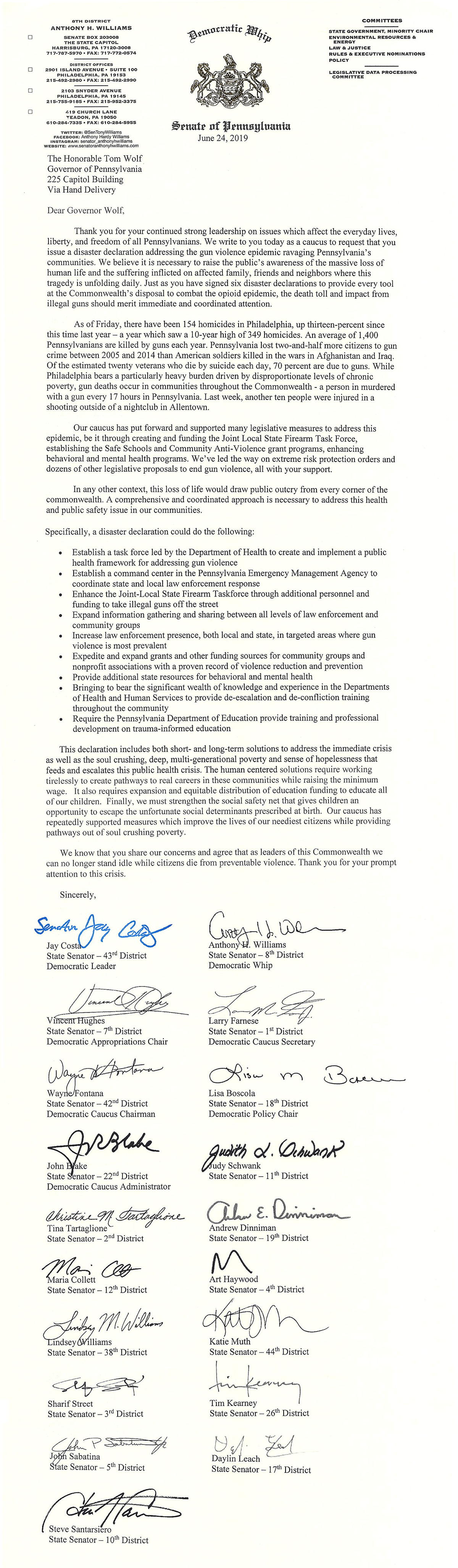
Harrisburg, Pa. − June 24, 2019 − Members of the Pennsylvania Senate Democratic Caucus today jointly sent a letter to Governor Tom Wolf requesting a disaster declaration for gun violence in the Commonwealth.
“We believe it is necessary to raise the public’s awareness of the massive loss of human life and the suffering inflicted on affected family, friends and neighbors where this tragedy is unfolding daily,” they wrote. “Just as you have signed six disaster declarations to provide every tool at the Commonwealth’s disposal to combat the opioid epidemic, the death toll and impact from illegal guns should merit immediate and coordinated attention.”
Specifically, a disaster declaration could do the following:
- Establish a task force led by the Department of Health to create and implement a public health framework for addressing gun violence
- Establish a command center in the Pennsylvania Emergency Management Agency to coordinate state and local law enforcement response
- Enhance the Joint-Local State Firearm Taskforce through additional personnel and funding to take illegal guns off the street
- Expand information gathering and sharing between all levels of law enforcement and community groups
- Increase law enforcement presence, both local and state, in targeted areas where gun violence is most prevalent
- Expedite and expand grants and other funding sources for community groups and nonprofit associations with a proven record of violence reduction and prevention
- Provide additional state resources for behavioral and mental health
- Bringing to bear the significant wealth of knowledge and experience in the Departments of Health and Human Services to provide de-escalation and de-confliction training throughout the community
- Require the Pennsylvania Department of Education provide training and professional development on trauma-informed education
View full letter →
###